
Image:
Descriptor:
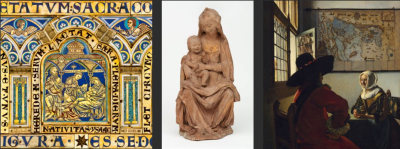
A visual commentary for Genesis 21:6 using three art pieces that share the common theme of the laughter God has made over time.
Paid Resource:
N
Requires FREE Account:
N
Source:
Visual Commentary on Scripture
Related to Children or Youth:
N
Audio/Video:
N
Full Text:
Laughter Woven into Time
Comparative commentary by Gabriel Torretta, O.P.
Bible Passage
The great events of God do not appear and disappear like waves in the ocean. They emerge but do not pass away; they are no longer seen but remain as they have always been. They pull at the fabric of the world, tugging at the threads of past and future with the immense weight of the present. Each event prepares for itself with prefigurations and repeats itself in future echoes. Aged and childless, Abraham and Sarah beget Isaac by divine gift (Genesis 21:1–7). Manoah’s barren wife is told by an angel that she will bear the Nazirite Samson (Judges 13:2–24). A virgin betrothed to a man named Joseph hears the angelic herald and conceives the Son of the Most High (Luke 1:26–38).
The laughter of God tugs at history with this same force, pulling all time toward itself. ‘He who sits in the heavens laughs’, says the Psalmist, and speaking of the wicked he continues, ‘the Lord has them in derision’ (Psalm 2:4). But the biblical sense of divine laughter is far more than mere mockery. The laughter of God is his providence, his covenant relationship with humanity, the fulfilment of mercy and justice in a joyous unity.
Sarah is the first to put words to this understanding, with her declaration that ‘God has made laughter for me’; but the laughter of Isaac, the laughter of seeing God’s covenant take flesh before one’s eyes, is a gift for all people: ‘every one who hears will laugh over me’ (Genesis 21:6).
Nicholas of Verdun’s image of the birth of Isaac visually enacts the universal promise of Sarah’s laughter, both by the covenant associations of the central lamp and by the concentration of every gaze on the nursing Isaac, whose name means ‘he laughs’. We know to expect Abraham and Sarah in the scene, but Nicholas invites the viewer more intimately into the sacred action in the person of the humble nursemaid, who veils her hands in preparation to touch God’s gift of laughter. The viewer, too, belongs to Sarah’s ‘every one’, and we, too, have the dignity of receiving the laughter of God’s covenant promise.
Not all laughter is a holy thing. The Psalmist shows laughter’s ugly face when, speaking in the voice of the persecuted Just One of God, he says that ‘all who see me mock at me’ (Psalm 22:7). The evangelists present the crowd on Golgotha unwittingly enacting this psalm in their mockery of Jesus (Matthew 27:39–44; Mark 15:29–32; Luke 23:35–39), which Matthew underscores by having Christ’s dying words be the incipit verse of the psalm (Matthew 27:46).
The free and easy laughter of Mary and Jesus in the Victoria and Albert terracotta statue makes a dramatic contrast with such troubled laughter. But how does one move from the sneering laughter of the sinner to the joyous laughter of the saint? The sculptor presents sacred laughter as a gift of grace. Mary smiles with the joy of one who is full of grace (Luke 1:28), as indicated by the enduring angelic presence perched atop her head. The Christ in the sculpture is presented as ‘the new Isaac’, the definitive incarnation of God’s laughter, who will take unto himself the cruel mockery of the cross and transform it into the true laughter of redemption. The time-bending pull of laughter joins Sarah’s words and Mary’s: ‘God has made laughter for me’, so ‘all generations will call me blessed’ and ‘will laugh over me’ (Luke 1:48; Genesis 21:6).
The kaleidoscopic possibilities of Johannes Vermeer’s Officer and Laughing Girl sit in the very centre of the straining threads of laughter’s past, present, and future. Is her laughter the fruit of the same world-weariness that produced Abraham’s dismissive laughter (Genesis 17:17–18), or of Sarah’s cynical disbelief (Genesis 18:12–15)? Is it the mocking, jeering laughter that preferred power to the life-giving humility of the cross? Or does this laughter, so suffused with light, radiate Sarah’s joy that the Lord has made laughter for her? Does it partake of Mary’s life of grace? Has it been transformed by the Christ-the-new-Isaac, by laughter made flesh? This intimate and open-ended painting is a question, an invitation, a challenge. The laughter of eternity pulls the threads of time. Dare I see the laughter God has made?
Content Type:
Key Scriptures:
Genesis 21:6
Mentioned Scriptures:
Genesis 17:17-18, 18:12-15, 21:1-7; Judges 13:2-24; Psalm 22:7; Matthew 27:39-44, 46; Mark 15:29-32; Luke 1:26-38, 48, 23:35-39
This sermon-related resource is based on a topic. I have selected the correct topic from the topic tags.:
Non English Resource:
Local Page:
Local Image: