
Image:
Descriptor:
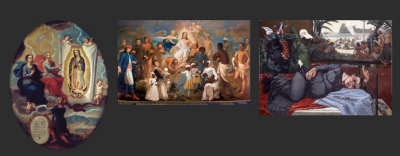
A visual commentary for Matthew 28:18-20 using three art pieces that share the common theme of the Great Commission.
Paid Resource:
N
Requires FREE Account:
N
Source:
Visual Commentary on Scripture
Related to Children or Youth:
N
Audio/Video:
N
Full Text:
Retellings and Reterritorializations
Comparative commentary by Johann Hinrich Claussen
Cite
Share
Show Bible Passage
Like the history of Christianity in general, the history of Christian mission is full of ambivalences and paradoxes. On the one hand, it is an expression of a perceived universality of the Gospel. Faith in the one God, revealed in the risen Jesus Christ, helps to fuel an understanding of global humanity: God's love is for all people, his justice should reign throughout the world. On the other hand, the spread of this faith in modern times is inseparable from—even if not identical with—the European subjugation of the world.
It is remarkable that it was only in modern times that ‘The Great Commission’ was understood in Europe as a call to global mission. The missionary theologian Ravinder Salooja dates this new understanding of the scriptural text to 1792, when the Baptist preacher William Carey from Leicester made Matthew 28:18–20 into the biblical basis for the obligation of Christians to evangelize ‘the Gentiles’.
Previously, other biblical passages had been important. For the Jesuit Roberto de Nobili, who worked in India in the seventeenth century, it was 1 Corinthians 9:20: ‘I became as a Jew to the Jews, that I might win the Jews’.
Part of what is astonishing about the fact that ‘The Great Commission’ became a guiding principle so late is that the unbounded reach of the proclamation of the risen Christ is here expressed so clearly. The new salvation and the new righteousness offered in Christ are presented as knowing no borders. Christ promises his support to all those who carry the faith in him and his commandments into the wide world.
However, it was not the large churches, but small groups, associations, and networks of enthusiastic activists—forerunners of today’s NGOs—that tried to put this into practice. Many of them saw themselves as the antithesis of Europe’s military and economic power. But they could only do their work within the structures of their time, that is, European and North American imperialism. The Moravians are a good example of these ambivalences. They were full of empathy for people in distant parts of the world, with little conscious desire for power. This attitude contrasts starkly with that of the colonizers, who considered the proselytization of indigenous peoples to be pointless.
The Herrnhuters recognized in indigenous people and enslaved peoples their fellow human beings. But just to get to them, which they believed was their calling, they had to use the means of transport of the imperialist powers and to reach an agreement with the colonizers. In some rare cases, they even owned enslaved people themselves, as has recently been discovered. What distinguishes the Moravians today—like several successor organizations of earlier missionary societies—is that they are now coming to terms with their ambivalent history.
Not only ambivalences, but also paradoxes characterize the history of Christian mission. Contrary to what ‘The Great Commission’ suggests, mission was never just the transfer of a message from one place to another. It inevitably changed depending on the culture it penetrated, the social needs it encountered, and the conflicts it became involved in.
The story of the Virgin of Guadalupe shows this more clearly than any other Christian image. At first, she was a figurative import from Spain. Then she was transformed into the icon of the Creoles in their fight against the Peninsulares. After the end of the colonial era, she served the mission of the indigenous people and became the symbol of Mexican nationalism. Today, in times of migration and mass-media popular culture, she is present in many places in Central, South, and North America—from graffiti to tattoos—and of course digitally.
After the end of the colonial era, the history of mission began to be critically examined. Since the 1970s, leading missionary organisations in Europe have turned away from the imperialist model of a mission aimed at conversion and have switched to partnership work—in some countries more quickly than in others. Portugal was particularly late, although the country’s most important artist, Paula Rego, was one of the first to create works that were decidedly critical of colonialism and missions. And rightly so, because a critical view of one’s own history is the basis for a better future. This applies to politics, economics, art, and of course religion.
A self-critical reappraisal of missionary history is the prerequisite for Christianity being able to make a contribution to a global culture of human rights today. However, it could also be of interest to the secular successors of Christian missionary organizations, who today advocate new moral universalisms, and on this basis travel to distant countries to spread their message.
References
Maier, Bernhard. 2021. Die Bekehrung der Welt. Eine Geschichte der christlichen Mission (München: C. H. BECK)
Salooja, Ravinder. 2024. ‘Climbing High Mountains’: Colonial Entanglement and Postcolonial Reflections (Leipziger Mission: Leipzig)
Sánchez, David A. 2008. From Patmos to the Barrio: Subverting Imperial Myths, Minneapolis: Fortress Press)
Tag:
Content Type:
Key Scriptures:
Matthew 28:18-20
Mentioned Scriptures:
Matthew 28:11-17; 1 Corinthians 9:20
This sermon-related resource is based on a topic. I have selected the correct topic from the topic tags.:
Non English Resource:
Local Page:
Local Image: