
Image:
Descriptor:
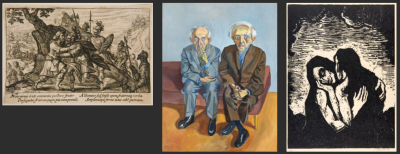
A visual commentary on Genesis 33:4 using three art works that focus on the reunion of Jacob and Esau.
Paid Resource:
N
Requires FREE Account:
N
Source:
Visual Commentary on Scripture
Related to Children or Youth:
N
Audio/Video:
N
Full Text:
Fraternal Frictions
Comparative commentary by Brad Anderson
Cite
Share
Show Bible Passage
Read by Ben Quash
In Genesis 32, Jacob and his family begin their journey back to Canaan, after the patriarch’s time with his uncle Laban and his family in Haran. Esau had vowed to kill his brother after Jacob stole Isaac’s blessing from him (Genesis 27:41), and this threat is in the background as the reader prepares for the reunion of the brothers in Genesis 33.
As he begins the journey back to Canaan, Jacob sends messengers ahead to his brother Esau who now lives in ‘the land of Seir, the country of Edom’ (32:3), both to alert his brother to his return, and perhaps to appease Esau with gifts (vv.3–5, 17–21). The messengers return and inform Jacob that Esau is coming to meet him, and that he has 400 men with him (v.6), a number that is repeated in 33:1. In response to this, Jacob divides his family into camps, from least important to those he values most, in order to minimize the damage should they be attacked.
As the brothers approach one another, the tension heightens. Esau runs towards his brother, and we are not sure of his intentions until he embraces Jacob, kissing him, as they both weep.
However, as is often the case, the relationship remains complicated. After some discussion between the brothers—including Jacob’s declaration that seeing Esau’s face is like seeing the face of God—Esau offers to accompany and travel with his brother. Jacob begs off, but promises to follow his brother to Seir; however, in the end he goes his own way—cautious, wary, and duplicitous to the end (33:12–17). This is the last we hear of the brothers together, until they reunite to bury their father Isaac (35:29).
The story of Jacob and Esau, and the reunion as recounted in Genesis 33, highlights a number of themes: the election of God’s chosen people, the humanity and imperfection of Israel’s ancestors, and the complicated relationships within families.
The artworks explored here help us to reflect on these issues.
Matthäus Merian the Elder’s detail-filled engraving reminds us of the broader context of the story of Jacob and Esau, as well as the history of interpretation that has understood these brothers in particular ways—including the idea that Esau is approaching with an army ready for battle.
The woodcut by Jacob Steinhardt focuses on the embrace of the brothers. While at first glance the viewer sees affection and tenderness, Steinhardt allows for other interpretations that point to the complex and ambiguous elements of the relationship.
Alice Neel’s portrayal of the Soyer brothers, meanwhile, offers a contemporary view on filial relationships, reminding us that kinship is often a fine balance of both connection and difference.
One of the compelling things about the Hebrew Bible is that it does not shy away from portraying the humanity of the characters in its stories—even the patriarchs. These figures, chosen and called by God, are nonetheless flawed and constantly grappling with real-life issues.
Reconciliation is one such example. The embrace and reconciliation of these brothers is a surprising and welcome development in this story, as is Jacob’s statement that seeing Esau’s face is like seeing the face of God.
However, it is not a fairy tale with a happy ending. Instead, the relationship remains complex. While the brothers in this scene do seem to reconcile, the weight of the past is not forgotten, and their fraught relationship will continue into the future, extending even to future generations as Israel and Edom become neighbouring nations who are often at odds.
Content Type:
Key Scriptures:
Genesis 33:4
Mentioned Scriptures:
Genesis 27:41, 32:1-21; 33, 35:29
This sermon-related resource is based on a topic. I have selected the correct topic from the topic tags.:
Non English Resource:
Local Page:
Local Image: